Posts

Showing posts with the label LEvidence

#22 Write a reflection on your own professional learning through this inquiry cycle.

Image
Write a reflection on your own professional learning through this inquiry cycle. To what extent was the intervention successful in changing teaching?  The changes in teaching resulted in student progress and improvement. We found our target learners were no longer "worried" or “scared” to go to a reading session. They ran to their reading workshop because they had felt successful in the structured nature of the sessions. The target learners ability to gain momentum and progress was the biggest success in this intervention. They were no longer not able to feel successful in their reading sessions.  It was successful in impacting on my planning and teaching, with which we shared with our team.  Our team has now made steps to adjust our junior school programme to align better with learning contexts that are more relevant to students needs when it comes to reading ... specific reading strategies are to be applied earlier in their learning journey rather than later....

#21 Overall evaluation

Image
Write an overall evaluation of your intervention in terms of the causal chain you had theorised. i.e. To what extent was the intervention successful in changing factors such as teaching? To what extent were those changes in teaching effective in changing patterns of student learning? This intervention has been successful in both changing factors in teaching and improving the progress of student support learners in literacy.  Changes to learners progress:  We recognised a HUGE problem, that year 3 and 4 learners were coming into our hubs without any skills to decode unknown words. The progressions we were designing our learning from throughout the school had a focus on the following skills: Name the parts of a book (front, back, spine, title) Explain the difference, and can give examples of, a letter, a word and a sentence Look for the difference between small letters and capital letters Show where to begin reading Read from left to right, starting at the top to the bottom of a...

#19 Summarise evidence about key changes in teaching and other factors that influence student learning.

Image
Summarise evidence about key changes in teaching and other factors that influence student learning. Evaluating shifts in teaching Aspect of teaching Evidence of teaching before intervention Evidence of teaching after intervention Judgement about how much you shifted  Explicitly model and teach them how to use specific thinking skills like ‘identify’, ‘explore’ and ‘notice’  in the learning process to break down the different elements of reading,    Video of teaching. Not using thinking skills explicitly.   Planning has changed. The slides explicitly state which thinking skills to use in each part of the SL sessions.  Use of cut up LP thinking skills so learners make connections.  I use the thinking skills intuitively in my teaching now.  Learners have more than doubled the amount they are using thinking skills to support them in their learning.  Explicitly teach literacy in a structured and consistent way through daily workshops, ST progress...

#18 Describing and Explaining the changes/tweaks you have made in your practice along the way.

Image
What evidence do you have about what you did differently?   We used to think that students learning was what needed to be changed; that when students did not understand, they had to read a lower level or we had to teach a lower strategy. We would continue to teach them the only way we knew how.  We had an opportunity and thought... perhaps we need to change how we  teach them...perhaps it's our own teacher practice that needs changing.  We decided that learning needed to be more engaging. We took into consideration the recent research on structured literacy and took bits and pieces of the research to create our own new programme. It was engaging and hands on. Our new programme included parts of structured literacy (phonics based approach) and repetition of key rules for reading. Learners finally experienced success in their reading!  T he effects of your changed practices/intervention: The data shows shift in ALL of our target learners. Some learners are now abl...

#17 How I will keep a record

Image
  Describe how you will keep a record of each of the above in a manageable way (‘cos you won’t otherwise remember all your many micro-decisions and why you made them) We will continue to add data to the above charts for each target learner. Those that are making accelerated progress will continue in Jess’s intervention group and those that are making less progress will repeat lessons with Emma.  Each week the learners complete a word work activity in their Structured Literacy books based on that weeks learning outcome. We use this as evidence of whether they can independently achieve the learning outcome. 

#16 informal & formal ways you are monitoring the effects of your changed practices/intervention on learner outcomes.

Image
  Identify informal & formal ways you are monitoring the effects of your changed practices/intervention on learner outcomes.  Explain the reflections and tweaks you are making along the way (Don’t wait to the end of your inquiry cycle and find it didn’t work) We are regularly testing our target learners on their progress. We are using Running Records, spelling tests from Liz Kane’s ‘The Code and the structured literacy assessment from Little Learners Love Literacy.  Through these formal assessments and informal observations in the target interventions, we have decided to split the group into 2 where some learners will continue with the iDeal Scope and Sequence and some learners will repeat the lessons. We will continue to monitor these as we go.

#12 Present findings from this inquiry about your teaching.

Image
  Present findings from this inquiry about your teaching. Ensure qualitative data includes rich descriptions of your teaching and quantitative data is clearly presented. In the past I have based my guided reading sessions off Schooltalk progressions. For the emergent reading levels, these progressions focus on learning sight words and stretching out sounds in words.  These lessons have worked for SOME learners, but not all. In particular not for my target learners. We have designed a new lesson structure based off the iDeal Scope and Sequence progressions as well as conversations with our amazing RTLB, Wendy and research from readings etc. These workshops happen every day and are structured around the Stonefield's Learning Process thinking skills. 

#8 How the data will be used as baseline data at the end of the year

Image
  Explain how some of the data you have used to build a profile of the students’ learning will be used as baseline data at the end of the year. As you can see in post #4,  we have collected formative assessment data from Running Records, Little Learners Love Literacy and Liz Kane's 'The Code' spelling tests to gather baseline evidence for where our target learners are sitting at the beginning of the year. We will use these assessments throughout the year and will monitor their progress. If we notice that there has been no shift in the data at the middle of this inquiry, we will revaulate.  We have also decided to monitor the wellbeing of these learners. Stonefield's has developed a Wellbeing Assessment Tool called Te Whare Tapa Wha. We will use this to monitor the wellbeing of learners at the beginning of the year and the end.  We are also able to track their wellbeing progressions through Schooltalk. Below is a snapshop of target learners wellbeing gap analysis:...

#7 The Nature and Extent of the Student Challenge

Image
  Share your findings about the nature and extent of the student challenge. Make sure it is clear what evidence from your inquiry supports each finding. Our Schoolwide Teaching Learning and Assessment Cycle shows how we will Notice, Recognise and Respond to our target learners as we complete our inquiry. It shows how we will integrate the Learning Process into our inquiry.  The following doc outlines the nature and extent of the student challenge with evidence from assessment data. It goes into detail about hypotheses and the method we wish to trial:  Photos of evidence showing misconceptions and interventions taking place within our target group allow the ability to track progress over time and have tangible evidence. 

#6 Begin collecting evidence and data

Image
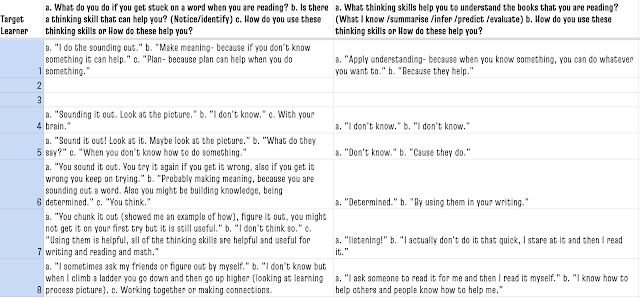
  6. Begin to collect evidence and data  and come to the next session ready to share your preliminary findings about the nature and extent of the student challenge i.e. using your baseline student data and evidence Learner Voice:  We have asked our target learners the following questions to see if they understand which Learning Process Thinking Skills they use in reading?  What do you do if you get stuck on a word when you are reading? Is there a thinking skill that can help you? (Notice/identify) How do you use these thinking skills or How do these help you?  What thinking skills help you to understand the books that you are reading? (What I know / summarise /infer /predict / evaluate ) How do you use these thinking skills or How do these help you? Below is the data we collected: Structured literacy data: We are using the Little Learners Love Literacy assessment tools to measure how our target group are progressing. Some common noticing's are that learners are...

#5 Describe tools/measures/approaches you plan to use

5.  Describe the tools/measures/approaches you plan to use to get a more detailed and accurate profile of students’ learning in relation to that challenge. Justify why you chose these approaches and tools. Learner voice T1 and T4 - this will give us an idea of what thinking skills the learners think help them with their reading. For this measure, we are interested in finding out whether they know which thinking skills to help them decode unknown words as well as their comprehension of texts they read.   Structured Literacy Assessment - For structured literacy, we are using the Little Learners Love Literacy assessment tool. We will assess the learners every 5-8 weeks to see if they are making shift Running record data - T1, T2, T3 and T4 - with the support of our amazing PLD facilitator, Jenny Thompson, we have discussed using running records as more of a formative assessment during our reading sessions with our target learners. During our term 1 data collection we are tryin...

Inquiry Evaluation 2021

   Target group T1 T2 T4 OTJ Spelling Vocabulary Target learner 1 1P 1P 2P Y1 - Y2 2P Target learner 2 1B 1A 2P Y1 - Y2   Target learner 3 1B 1P 1P Y1 - Y2   Target learner 4 1P 2P 2P Y2 - Y3 2P Target learner 5  1A 1A 2P Y1 - Y3 2P Target learner 6  2P 1A 2A Y1 - Y2 2A Target learner 7 1B 1P 1A Y1 - Y2 1A As you can see in this table, all learners have made progress in their writing since term 1. However, the two highlighted in orange did not make any progress from term 2, to term 4. It is important to note that these 2 learners had low online attendance and one of these learners never returned to school in term 4.  Spelling:  I was pleased to observe in the learners writing books that all learners had made progress in spelling. Some feedback from parents in our Digital Learning Converstaions in term 4 was that they appreciated having the spelling notebooks and spelling rules coming home as it was something they could support with. I will definit...