Posts

Showing posts with the label CPlan

#14 Causal Chain

Image
  Restate your inquiry question and your theory of action/chain of events (so you keep your eyes on the prize) To what extent does explicitly teaching of the Learning Process thinking skills impact learners shifts/achievement in Reading?

#12 Present findings from this inquiry about your teaching.

Image
  Present findings from this inquiry about your teaching. Ensure qualitative data includes rich descriptions of your teaching and quantitative data is clearly presented. In the past I have based my guided reading sessions off Schooltalk progressions. For the emergent reading levels, these progressions focus on learning sight words and stretching out sounds in words.  These lessons have worked for SOME learners, but not all. In particular not for my target learners. We have designed a new lesson structure based off the iDeal Scope and Sequence progressions as well as conversations with our amazing RTLB, Wendy and research from readings etc. These workshops happen every day and are structured around the Stonefield's Learning Process thinking skills. 

#9 My Hypotheses

Image
  Your hypotheses about the kinds of teaching that are most likely to shift student learning in the directions you have identified.

#5 Describe tools/measures/approaches you plan to use

5.  Describe the tools/measures/approaches you plan to use to get a more detailed and accurate profile of students’ learning in relation to that challenge. Justify why you chose these approaches and tools. Learner voice T1 and T4 - this will give us an idea of what thinking skills the learners think help them with their reading. For this measure, we are interested in finding out whether they know which thinking skills to help them decode unknown words as well as their comprehension of texts they read.   Structured Literacy Assessment - For structured literacy, we are using the Little Learners Love Literacy assessment tool. We will assess the learners every 5-8 weeks to see if they are making shift Running record data - T1, T2, T3 and T4 - with the support of our amazing PLD facilitator, Jenny Thompson, we have discussed using running records as more of a formative assessment during our reading sessions with our target learners. During our term 1 data collection we are tryin...

# 4 Explain why you judge this to be the most important and catalytic issue of learning for this group of learners this year

  # 4 Explain why you judge this to be the most important and catalytic issue of learning for this group of learners this year This is my second year teaching some of these target learners literacy. For some of my student support learners, they have been reading at red/yellow for almost a year now. I need to figure what will work for these learners.  What will support these learners to develop their phonological and phonemic awareness? How will I give learners the strategies to decode words?   What will help develop a love of reading for these learners?  How can whānau support their children at home with reading? My wondering is that if I can make it work for these learners, then I will have the tools and strategies to lift achievement of all learners.

#1 Summarise the challenge of student learning you plan to focus on in this inquiry

Image
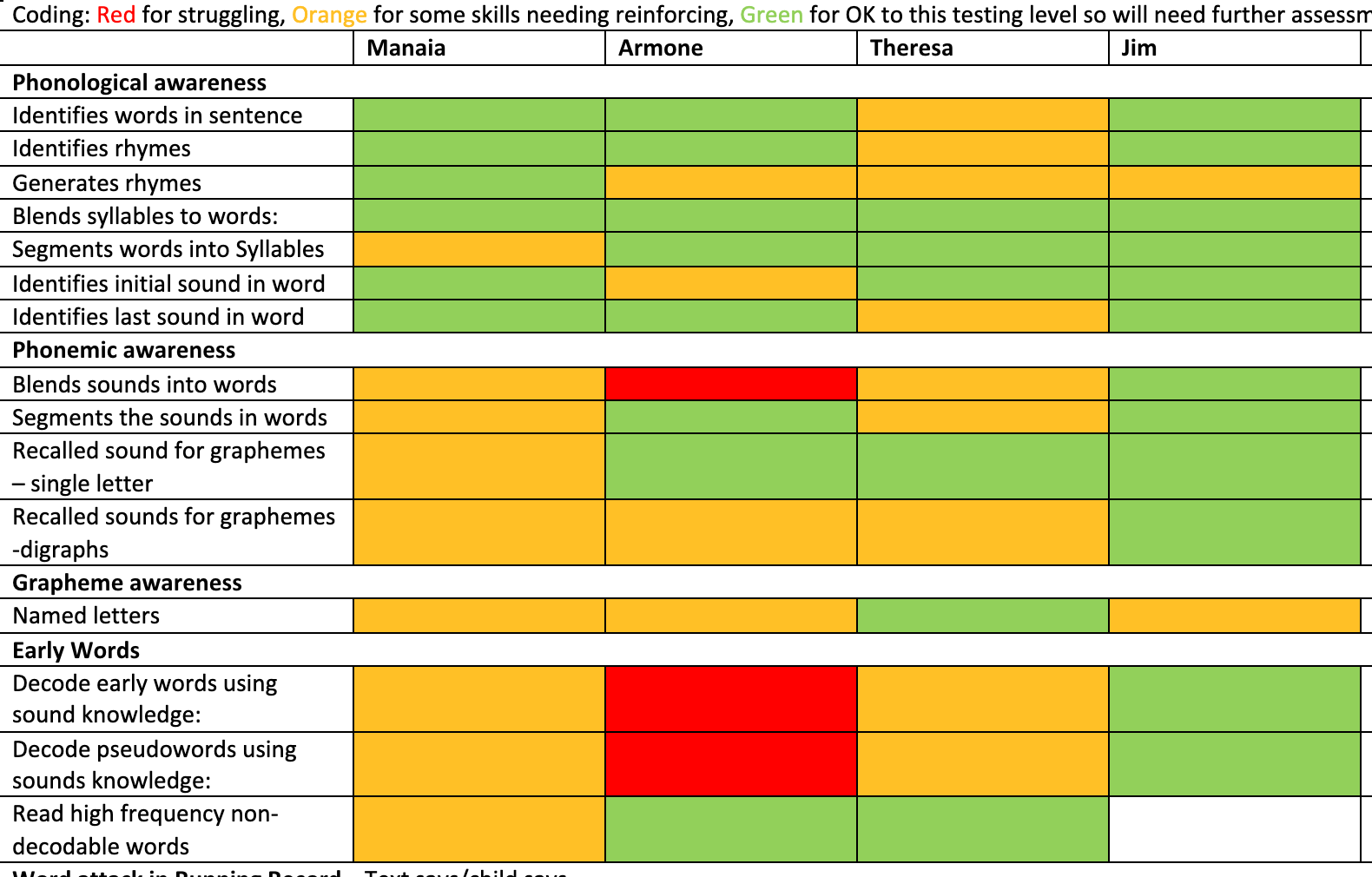
#1 Summarise the challenge of student learning you plan to focus on in this inquiry. Be as clear and specific as you can about the evidence you have about this to date.  This year has started off so well! Our learners have settled in to their new hub and my amazing hub mate Jess and I have set up great routines in the hub. We feel very fortunate to have a group of children who are keen to dive straight into the learning.  We have identified that literacy learning is a need in our hub. We have 12 learners who are working below where they should be for reading. We have learners working within red, yellow, blue, green and orange levels of the colour wheel. We have identified that the learners in these groups are either ESOL learners or are on our Student Support register.  We have decided to focus on ‘Improve the achievement of students with additional needs in the learning areas of English/key competency using language symbols and texts’ Reading Data - Term 1 2022   Re...

#11 Causal Chain

Image
Causal Chain - Why is thinking about a causal chain important before you design your intervention? The purpose is to tighten up your intervention and to understand more deeply  what you did that resulted in a shift in student achievement

#8 Evidence I will use to track progress

Explain how some of the data you have used to build a profile of the students’ learning will be used as baseline data at the end of the year. Learner voice: I will use the learner voice survey at at least 3 points of the year so I can compare how the learners are tracking. I hope to add in a question about how they are giving and receiving feedback and whether this helps them to understand the next steps or not.  Gap analysis: this will be an ongoing assessment tool throughout the year. As the learners and I upload evidence to Schooltalk, this will build a rich picture of how the learners are making progress in each goal.  Writing samples: Similar to Schooltalk, I will regularly be monitoring the progress of my target learners through their writing books and writing samples.  Easttle: This will be used as a beginning and end compare and contrast tool.

Blog post #8: Reflection

Image
In relation to my hypotheses, my research and observation feedback and reflection, I have discovered which areas I feel would be best to focus on and make changes to my practise.  These areas are:  - Engaging topics  - Opportunities for vocabulary building  - Opportunities for learners to give and receive feedback - Opportunities to explore strengths and interests  - Incorporate fitness into writing programme - Opportunities for mistakes to be made  - Separate handwriting and spelling  Below is a photo of my writing programme intervention: 

Blogging task #5: Use of baseline data at the end of the year

Task: Explain how some of the data you have used to build a profiles of the students learning will be used as baseline data at the end of the year.  How I will measure data throughout the year:  - Schooltalk Progressions  - EasTTle writing term 1 and 4  - Student voice survey  - Writing samples  How can I measure engagement using observations/videos of my teaching?  How can I include whanau voice in my data?  All of this data will be able to be compared to at the end of the year. I hope to see an increase in writing achievement in my target group of learners. I also hope that the student voice survey will be used as a measure for learner engagement.  I am still considering other tools that could measure learner engagement. Do I use lesson observations from other teachers in my hub? Or could I video my lessons now and compare them later in the year?  I am also considering how I can involve whanau in this inquiry. How can I use their voice...

Preliminary Findings

Image
Below are some of my preliminary findings about the nature and extent of my my achievement challenge (achievement of boys in writing).  e-asTTle results term 1:  Our e-asTTle results for term 1 showed that we have 47% of our hub below expected level for writing. As you can see in the graph above, there is a high percentage of gaps in spelling, punctuation and organisation.  This aligns with our year group data:  - Year 3 2019 -  Writing   67% met or exceeded expected levels - Year 4 2019 - Writing 71% met or exceeded expected levels Schooltalk gap analysis confirms this:

Tools/measures/approaches I plan to use

Image
Below are a list of tools/measures/approaches that I plan to use to  get a more detailed and accurate profile of students’ learning in relation to writing. e-asTTle writing data: I plan to use this data to compare the levels of progress from term 1 and term 4. This will show me areas in writing that the learners have improved on. The questionnaire at the beginning of the e-asTTle will also indicate if there has been a shift in learners viewpoints around writing.  Phonics/spelling assessment: I haven't decided the best way to measure this but I have been looking into Yolanda Soryl's phonics programme and how I might be able to do an assessment in Term 1 and Term 4 to measure the progress my learners have made in phonics.  Schooltalk gap analysis: A Schooltalk gap analysis will show me where my learners have gaps in their writing. I will be able to track and record the progress of my target learners throughout the whole year on Schooltalk.  Learner ...

TAI Post #11: Monitoring my inquiry

Image
My Inquiry so far: Term 3 2019 Main changes I have made to my teaching:  1. Introduce a range of different oral language activities and strategies in reading and writing.  2. Allow time for reflection in reading and writing time The first change was easy, I implemented a huge variety of games into my morning routine. We spent the first 15 minutes of the day playing games and talking. It was fun and the kids loved it!  These activities were transferred into our reading programme. Learners were being agentic by choosing the activities that they wanted to do during reading time through this magical map:  I found that these activities were fun and engaging for learners. They were being agentic by choosing games and activities that they enjoyed. But.. I wanted more. My goal was for the learners to develop agency in literacy. I wanted them to have a better understanding of their learning and next steps. My student voice showed that my learners STILL h...