Posts

#9 My Hypotheses

Image
  Your hypotheses about the kinds of teaching that are most likely to shift student learning in the directions you have identified.

#8 How the data will be used as baseline data at the end of the year

Image
  Explain how some of the data you have used to build a profile of the students’ learning will be used as baseline data at the end of the year. As you can see in post #4,  we have collected formative assessment data from Running Records, Little Learners Love Literacy and Liz Kane's 'The Code' spelling tests to gather baseline evidence for where our target learners are sitting at the beginning of the year. We will use these assessments throughout the year and will monitor their progress. If we notice that there has been no shift in the data at the middle of this inquiry, we will revaulate.  We have also decided to monitor the wellbeing of these learners. Stonefield's has developed a Wellbeing Assessment Tool called Te Whare Tapa Wha. We will use this to monitor the wellbeing of learners at the beginning of the year and the end.  We are also able to track their wellbeing progressions through Schooltalk. Below is a snapshop of target learners wellbeing gap analysis:...

#7 The Nature and Extent of the Student Challenge

Image
  Share your findings about the nature and extent of the student challenge. Make sure it is clear what evidence from your inquiry supports each finding. Our Schoolwide Teaching Learning and Assessment Cycle shows how we will Notice, Recognise and Respond to our target learners as we complete our inquiry. It shows how we will integrate the Learning Process into our inquiry.  The following doc outlines the nature and extent of the student challenge with evidence from assessment data. It goes into detail about hypotheses and the method we wish to trial:  Photos of evidence showing misconceptions and interventions taking place within our target group allow the ability to track progress over time and have tangible evidence. 

#6 Begin collecting evidence and data

Image
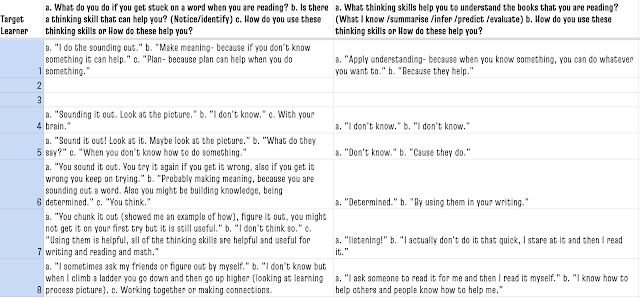
  6. Begin to collect evidence and data  and come to the next session ready to share your preliminary findings about the nature and extent of the student challenge i.e. using your baseline student data and evidence Learner Voice:  We have asked our target learners the following questions to see if they understand which Learning Process Thinking Skills they use in reading?  What do you do if you get stuck on a word when you are reading? Is there a thinking skill that can help you? (Notice/identify) How do you use these thinking skills or How do these help you?  What thinking skills help you to understand the books that you are reading? (What I know / summarise /infer /predict / evaluate ) How do you use these thinking skills or How do these help you? Below is the data we collected: Structured literacy data: We are using the Little Learners Love Literacy assessment tools to measure how our target group are progressing. Some common noticing's are that learners are...

#5 Describe tools/measures/approaches you plan to use

5.  Describe the tools/measures/approaches you plan to use to get a more detailed and accurate profile of students’ learning in relation to that challenge. Justify why you chose these approaches and tools. Learner voice T1 and T4 - this will give us an idea of what thinking skills the learners think help them with their reading. For this measure, we are interested in finding out whether they know which thinking skills to help them decode unknown words as well as their comprehension of texts they read.   Structured Literacy Assessment - For structured literacy, we are using the Little Learners Love Literacy assessment tool. We will assess the learners every 5-8 weeks to see if they are making shift Running record data - T1, T2, T3 and T4 - with the support of our amazing PLD facilitator, Jenny Thompson, we have discussed using running records as more of a formative assessment during our reading sessions with our target learners. During our term 1 data collection we are tryin...

# 4 Explain why you judge this to be the most important and catalytic issue of learning for this group of learners this year

  # 4 Explain why you judge this to be the most important and catalytic issue of learning for this group of learners this year This is my second year teaching some of these target learners literacy. For some of my student support learners, they have been reading at red/yellow for almost a year now. I need to figure what will work for these learners.  What will support these learners to develop their phonological and phonemic awareness? How will I give learners the strategies to decode words?   What will help develop a love of reading for these learners?  How can whānau support their children at home with reading? My wondering is that if I can make it work for these learners, then I will have the tools and strategies to lift achievement of all learners.

# 3 Chat with Gina (Year ¾ Associate Principal)

  # 3 Chat with Gina (Year ¾ Associate Principal) Progressions of hauora on ST and see where they are at in those progressions.  Agency tool (well-being) and Te Whare Tapa Wha tool.  Present data- holistic approach. Measure well-being and the impact.  Is it achievable to connect the two- well-being and achievement tool.  Measure it again by the end of the term to see the shift.  Gathering data- baseline at beginning of term 1, data set at the end of the term. Hauora indicators that reflects our concept.  Writing pieces in term one is evidence.  Use the learning process to co-construct strategies, identify the 3 main ideas. Talk about the thinking skill and the definition. Connect to prior knowledge (what I know), practise etc.  Unpacking thinking skills in LP and weave in to the different tools and strategies.  Explicit teaching Data… COVID dip? Year 2s in reading- acceleration in reading online.  2 target groups: one ESOL and one S...